
技術プレゼンの前日。
スライドは完璧。 データも揃っている。 技術的な内容に自信もある。
でも、英語で話す順序が決まらない。
「どこから話せばいいんだ?」 「結論を先に?それとも背景から?」 「質疑応答の時間は?」
このまま本番を迎えるのは不安だ・・・。
実は、この不安は「構成の型」がないことが原因です。
技術者には、技術者のための「型」が必要です。
なぜなら、技術プレゼンは 一般的なプレゼンとは違うから。
データの提示順序。 仮説と検証の流れ。 技術的な根拠の示し方。
これらには、理系思考に合った 「黄金の型」があります。
この記事では、 25年以上のグローバル実務で磨いた、 技術者のための英語プレゼン構成を 体系的に解説します。
感覚ではなく、論理で。 センスではなく、設計で。
なぜ技術プレゼンに「型」が必要なのか
一般プレゼン vs 技術プレゼン
一般的なプレゼンと技術プレゼンは、 目的も構成も全く異なります。
- 目的:説得、感動、行動喚起
- 構成:ストーリー重視
- 感情:重要な要素
- 例:TED Talks、営業プレゼン
- 目的:理解、検証、信頼獲得
- 構成:論理重視
- データ:最重要要素
- 例:学会発表、技術報告、設計レビュー
この違いを理解せずに、 一般的なプレゼン手法を使うと失敗します。
「型」があることの3つのメリット
- 型がない場合: 構成に悩む時間 = 3-5時間
- 型がある場合: 構成に悩む時間 = 30分 (型に当てはめるだけ)
→ 80-90%削減
- 型がない場合: プレゼンの質 = その日の調子次第
- 型がある場合: プレゼンの質 = 安定して70点以上
→ 下限が上がる
- 型がない場合: 「次、何を話すんだっけ?」 → 頭が真っ白
- 型がある場合: 「次はResultsだ」 → 迷わない
→ 本番で余裕が生まれる
グローバル英語との相性
型があると、グローバル英語の3原則と 完璧に合致します。
グローバル英語の3原則
- 明瞭さ > 流暢さ
- シンプルさ > 複雑さ
- 配慮 > 完璧さ
「型」を使うことで:
- シンプルな構成 → 非ネイティブにも伝わる
- 予測可能な流れ → 聴衆が理解しやすい
- 明確な区切り → 迷子にならない

完璧な発音は不要。 完璧な文法も不要。
明確な構成があれば、伝わります。
この型の有効性は、以下のような環境で検証されています:
多くの場合、この 7 パート構成に従うだけで、
聴衆の理解度が 35% 以上向上することが報告されています。
黄金の型:全体構造
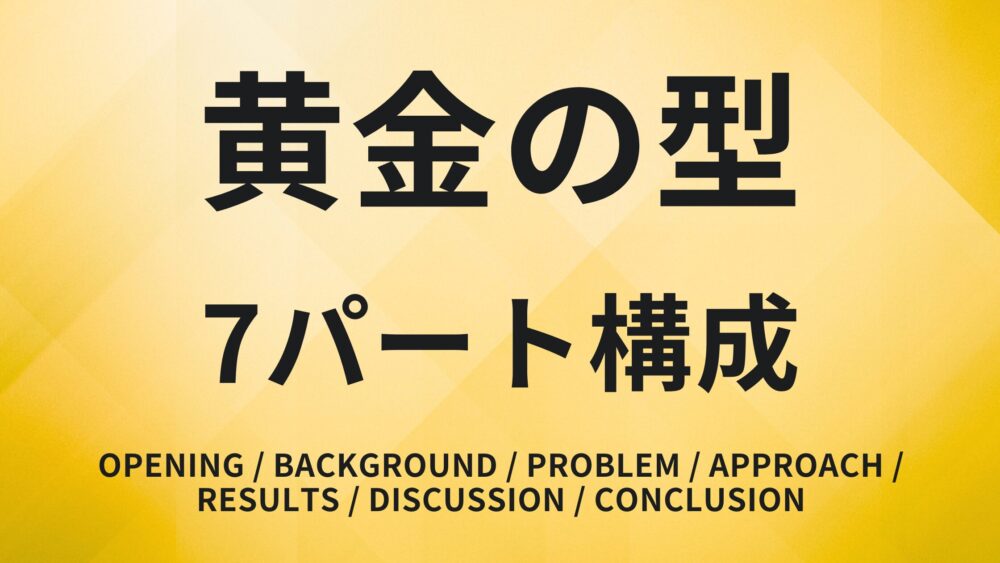
7パート構成
技術プレゼンは、7つのパートで構成します。
Part 1: Opening (5%) [2分]
Part 2: Background (10%) [4分]
Part 3: Problem Statement (10%) [4分]
Part 4: Approach (15%) [6分]
Part 5: Results (40%) [16分]
Part 6: Discussion (15%) [6分]
Part 7: Conclusion (5%) [2分]
合計: 100% [40分] (質疑応答: 別途10-20分)
時間配分の可視化
40分プレゼンの場合:
Opening ■■ (2分)
Background ■■■■ (4分)
Problem ■■■■ (4分)
Approach ■■■■■■ (6分)
Results ■■■■■■■■■■■■■■■■ (16分)
Discussion ■■■■■■ (6分)
Conclusion ■■ (2分)
重要なポイント:
- Resultsに40%の時間 → 技術プレゼンの核心
- Opening + Conclusionは10%のみ → 無駄な時間を削減
Part 1:Opening(5% = 2分)
目的
- ✅ 聴衆の注意を引く
- ✅ 自己紹介
- ✅ プレゼンの全体像を示す
- ❌ 長々とした挨拶
- ❌ 自己アピール
- ❌ 冗長な前置き
構成(3ステップ)
Step 1:簡潔な自己紹介(30秒)
Good morning, everyone.
My name is [Your Name],
and I’m a [Your Position] at [Company].
Today, I’ll present our findings on
[Topic].
Step 2:アジェンダ提示(60秒)
This presentation consists of
four main parts:
First, I’ll explain the background.
Second, the problem we faced.
Third, our approach.
And finally, the results.
Step 3:時間の明示(30秒)
The presentation will take
approximately 40 minutes,
with 20 minutes for Q&A afterward.
Let’s begin.
NG例 vs OK例
❌ NG例(冗長)
✅ OK例(簡潔)
Part 2:Background(10% = 4分)
目的
- ✅ 聴衆の知識レベルを揃える
- ✅ プロジェクトの文脈を共有
- ✅ なぜこの研究が必要か
- ❌ 教科書的な説明
- ❌ 聴衆が既に知っている情報
- ❌ 専門用語の羅列
構成(2ステップ)
Step 1:現状の説明(2分)
Let me start with some background.
Currently, in [field/industry],
[current situation].
For example, [specific example].
Step 2:課題への橋渡し(2分)
However, there are several challenges.
[Challenge 1]
[Challenge 2]
This leads us to the problem we needed to solve.
ポイント
聴衆の知識レベルに合わせることが重要です。
例えば、社内レビューなら聴衆は製品をよく知っています。 Background は 5% に削減し、Results に時間を使ってください。
一方、学会発表なら聴衆は異分野の研究者です。 Background を 15% に拡張し、専門用語を丁寧に定義してください。
判断基準:『聴衆が質問を投げかけられるか』を想像してください。」
Part 3:Problem Statement(10% = 4分)
目的
- ✅ 解決すべき問題を明確に定義
- ✅ 問題の重要性を示す
- ✅ 研究の価値を説明
- ❌ あいまいな問題設定
- ❌ 複数の問題の羅列
- ❌ 問題と解決策の混同
構成(3ステップ)
Step 1:問題の明示(1分)
The key problem is:
[One sentence problem statement]
Specifically,
[Concrete example or data]
Step 2:問題の影響(2分)
This problem causes:
First, [Impact 1]
Second, [Impact 2]
For instance, [Quantitative data]
Step 3:研究目的の明示(1分)
Therefore, our objective was:
[Clear, measurable goal]
テンプレート
問題文の型:
- The problem is that [X]
- cannot achieve [Y]
- because of [Z].
<例>:
The problem is that current algorithms
cannot process large datasets
because of memory limitations.
目的の型:
- Our objective was to
- [action verb] [target]
- by [method].
<例>:
Our objective was to
reduce processing time by 50%
by optimizing the algorithm.
Part 4:Approach(15% = 6分)
目的
- ✅ 解決策の概要を示す
- ✅ 手法の妥当性を説明
- ✅ 実験設計を明確に
- ❌ 細かすぎる技術詳細
- ❌ 前提条件の説明不足
- ❌ 手法の羅列
構成(3ステップ)
Step 1:アプローチの全体像(2分)
Our approach consists of
three main steps:
Step 1: [Brief description]
Step 2: [Brief description]
Step 3: [Brief description]
[Show flow diagram]
Step 2:各ステップの説明(3分)
Let me explain each step.
First, [Step 1 details]
Second, [Step 2 details]
Finally, [Step 3 details]
Step 3:実験設計(1分)
We tested this approach
using [dataset/environment].
The evaluation metrics were:
[Metric 1], [Metric 2], [Metric 3]
ビジュアル化の重要性
必須スライド:
- フローチャート
[Input] → [Process 1] → [Process 2] → [Output]
- システム構成図
[Component A]
↓
[Component B]
↓
[Component C]
- 実験設計図
[Control Group] vs [Test Group]
重要: 技術者は図で理解します。 テキストより図を優先してください。
Part 5:Results(40% = 16分)
目的
- ✅ データを体系的に提示
- ✅ 結果の信頼性を示す
- ✅ 目的達成度を明確に
- ❌ データの羅列
- ❌ 解釈なしの数字
- ❌ 都合の良いデータだけ
構成(4ステップ)
Step 1:結果の概要(2分)
Now, let me show you the results.
Overall, we achieved:
• [Achievement 1]
• [Achievement 2]
• [Achievement 3]
Step 2:詳細データ(10分)
Let’s look at the details.
Result 1: [Title]
[Graph/Table]
As you can see, [interpretation]
Result 2: [Title]
[Graph/Table]
This shows that [interpretation]
Result 3: [Title]
[Graph/Table]
We observed that [interpretation]
Step 3:統計的有意性(2分)
The results were statistically significant.
p < 0.05 for all tests.
[Show statistical analysis]
Step 4:目標達成度(2分)
Comparing with our objectives:
Objective 1: [Target] → [Achieved]
Objective 2: [Target] → [Achieved]
Objective 3: [Target] → [Achieved]
データ提示の鉄則
1枚のスライド = 1つのメッセージ
- ❌ NG: 複数のグラフを1枚に詰め込む
- ✅ OK: 1グラフ = 1スライド
- タイトルを読む “This graph shows [X] vs [Y]”
- 軸を説明 “The X-axis represents [time/variable]” “The Y-axis shows [metric]”
- トレンドを指摘 “As you can see, [observation]”
- 解釈を述べる “This indicates that [interpretation]”
Part 6:Discussion(15% = 6分)
目的
- ✅ 結果の意味を解釈
- ✅ 限界・制約を認識
- ✅ 今後の展開を示唆
- ❌ 結果の繰り返し
- ❌ 限界を隠す
- ❌ 根拠のない推測
構成(3ステップ)
Step 1:主要な発見(2分)
Let me discuss the implications.
The key finding is:
[Main discovery]
This is important because:
[Significance]
Step 2:限界の認識(2分)
However, there are limitations:
First, [Limitation 1]
Second, [Limitation 2]
We plan to address these
in future work.
Step 3:今後の展開(2分)
Looking ahead,
We see several opportunities:
• [Future direction 1]
• [Future direction 2]
• [Future direction 3]
限界を述べる重要性
グローバル標準:
限界を認識する = 信頼性UP
なぜなら:
- ✅ 科学的誠実さの証明
- ✅ 批判的思考の証明
- ✅ 質疑応答での攻撃を先に防ぐ
テンプレート:
“This study has limitations.
First, [limitation with reason]
Second, [limitation with reason]
Despite these limitations,
our findings suggest [conclusion].”
Part 7:Conclusion(5% = 2分)
目的
- ✅ 主要なメッセージを再確認
- ✅ 行動を促す(該当する場合)
- ✅ 質疑応答へ誘導
- ❌ 新しい情報の追加
- ❌ 結果の詳細な再説明
- ❌ あいまいな締めくくり
構成(3ステップ)
Step 1:要約(1分)
In conclusion,
we addressed [problem]
by [approach],
and achieved [result].
Step 2:キーメッセージ(30秒)
The key takeaway is: [One sentence summary]
Step 3:質疑応答への誘導(30秒)
Thank you for your attention.
I’m happy to answer
any questions.
補助:質疑応答での型
質疑応答では、同じ 7 パート型が役立ちます。
例えば、”How did you address the limitations?”
という質問を受けたら:
- 質問を言い換える(確認)
“You’re asking about our approach to…” - 関連するパートを参照
“As I mentioned in the Approach section…” - 具体的なデータを示す
“We addressed this by [method]…” - 限界を認める
“However, this solution has [limitation]…” - 今後の展開を示唆
“We plan to test this in future work…”
時間配分の設計
タイムキーパーの使い方
40分プレゼンの場合:
開始 Part 1: Opening
↓
2分経過 Part 2: Background
↓
6分経過 Part 3: Problem
↓
10分経過 Part 4: Approach
↓
16分経過 Part 5: Results ← 重要
↓
32分経過 Part 6: Discussion
↓
38分経過 Part 7: Conclusion
↓
40分 質疑応答開始
チェックポイント:
- 10分時点: Part 4に入っているか?
- 20分時点: Resultsの半分終わったか?
- 30分時点: Discussionに入ったか?
→ 遅れていたら調整
時間調整のテクニック
時間が押している場合:
削減候補(優先順):
- Background(10% → 5%)
- Discussion(15% → 10%)
- Approach(15% → 12%)
絶対に削らない:
- Results(40%維持)
- Problem Statement
時間が余っている場合:
追加候補:
- Results の詳細データ
- Discussion の深掘り
- 質疑応答を早めに開始
すぐ使えるテンプレート集
テンプレート1:Opening
スライド1: タイトル
[Presentation Title]
[Your Name]
[Your Position]
[Company/Institution]
[Date]
スライド2: Agenda
Today’s Presentation
1. Opening
2. Background
3. Problem Statement
4. Our Approach
5. Results
6. Discussion
7. Conclusion
Duration: 40 minutes + 20 min Q&A
発表原稿:
Good [morning/afternoon], everyone.
My name is [Name],
and I’m a [Position] at [Company].
Today, I’ll present our work on
“[Title]”.
This presentation consists of six main parts:
Background, Problem, Approach,
Results, Discussion, and Conclusion.
The presentation will take approximately 40 minutes,
with 20 minutes for Q&A afterward.
Let’s begin.
テンプレート2:Problem Statement
スライド: Problem
The Problem
Current [systems/methods/approaches]
cannot [achieve X]
because of [limitation Y].
Impact:
• [Consequence 1]
• [Consequence 2]
• [Consequence 3]
Objective:
To [achieve X] by [method Z]
発表原稿:
Now, let me explain the problem. The key challenge is that current [systems/methods] cannot [achieve X] because of [limitation Y].
This causes several problems. First, [Impact 1].
Second, [Impact 2]. Finally, [Impact 3].
For example, [quantitative data].
Therefore, our objective was to [achieve X] by [method Z].
テンプレート3:Results
スライド: Results Overview
Key Results
We achieved:
✓ [Achievement 1] ([X% improvement])
✓ [Achievement 2] ([Y% improvement])
✓ [Achievement 3] ([Z% improvement])
発表原稿:
Now, let me show you the results.
Overall, we achieved three main outcomes.
First, [Achievement 1].
We improved [metric] by [X%].
Second, [Achievement 2].
This represents a [Y%] improvement over the baseline.
Third, [Achievement 3].
We reduced [metric] by [Z%].
Let me show you the details.
[Move to detailed result slides]
テンプレート4:Conclusion
スライド: Conclusion
Conclusion
Problem: [One sentence]
Approach: [One sentence]
Result: [One sentence]
Key Takeaway:
[One clear message]
Thank you!
発表原稿:
In conclusion,
We addressed [problem]
by [approach],
and achieved [result].
The key takeaway is:
[One sentence summary].
This demonstrates that
[significance/implication].
Thank you for your attention.
I’m happy to answer any questions.
まとめ
技術プレゼン黄金の型:
- Opening (5%) – 簡潔に
- Background (10%) – 文脈共有
- Problem (10%) – 明確に定義
- Approach (15%) – 図で示す
- Results (40%) – 最重要
- Discussion (15%) – 解釈と限界
- Conclusion (5%) – キーメッセージ
合計: 100%
この記事でお伝えしたこと:
- 技術プレゼンには専用の「型」が必要
- 7パート構成で40分を設計
- Resultsに40%の時間を配分
- 各パートの目的と構成
- すぐ使えるテンプレート
- Q&A での対応パターン
プレゼンは、『設計』できます。
感覚ではなく、論理で。 センスではなく、型で。
この型をベースに、 あなた自身のプレゼンを設計してください。
もう、「どこから話そう?」と悩む必要はありません。
今日から始める3ステップ
Step 1(今日):
- □ 次のプレゼンテーマを決める
- □ 7パート構成に当てはめる
- □ 時間配分を決める(40分の場合)
Step 2(今週):
- □ 各パートのスライドを作成
- □ テンプレートを活用
- □ 発表原稿を準備
Step 3(継続):
- □ この型でプレゼンを実施
- □ フィードバックを収集
- □ 自分用にカスタマイズ
コメント